As humans we adjust to the environment around us. For example, take three medium sized bowls and fill them with water. One cold, one hot (but not too hot), and one somewhere in the middle. Place one hand in the cowl of cold water and the other in the bowl of hot water and keep them there for about a minute. Now place both hands in the lukewarm bowl of water together. You should notice that the hot water hand feels cold and the cold water hand feels hot.
About three year ago I traveled outside of the US for the first time in my life (no, the day trip to Juarez at age 6 doesn’t count). I left the laid back atmosphere of Hawai`i and upon arriving in Seoul was immediately taken aback by how aggressive and forceful everyone seemed, how traffic laws were seemingly regarded as suggestions, and the haphazard way people seemed to walk, choosing to adhere to neither the left nor the right of pedestrian throughways. Three years later, returning to South Korea after 2 years in Kenya my immediate impressions were that everyone is incredibly polite, traffic is a perfectly ballet of glass and steel coordinated by law abiding citizens, and that everyone except for me seems to know exactly where to walk while I meander aimlessly throughout the sidewalk. What happened? What changed? When did everything become so harmonious?
This morning, a German traveler, freshly arrived from Japan, commented to me on how taken aback he has been by how pushy and hostile people seem here. What changed? Apparently just me. Al Gore tells us that if you put a frog in boiling water it will jump out, but if you put it in tepid water then raise it to a boil you’ll be the proud owner of a dead, boiled frog. Never mind what kind of sadistic frog boiling sicko the former VP got this info from and don’t please try this at home, we’ll just assume they did their homework thoroughly before making their findings public. The point is that I didn’t realize how difficult life was in Kenya or how I was adapting until I went somewhere else.
I’ve learned that I after two years of not wearing deodorant that the smell of it is too overpowering. I can’t pass an electrical socket without thinking about what I can potentially charge at that given moment and I’m constantly thinking about where I can get clean drinking water. I view internet access as a finite commodity and I can’t look at pictures or videos without thinking about how much data I’m chewing up. I’m more comfortable holding hands with other men than you would expect from someone coming from a country where homosexuality is a crime punishable by up to 14 years in prison and I still prefer to squat when going to the bathroom when the option exists. I think about all purchases in terms of how many village lunches I could buy for the same price and find it hard to believe that restaurants actually have all of the foods listed on their menu available at any given time. I’m unused to the idea of events occurring exactly at a certain time, I find it odd to be outdoors after dark, and I still feel the need to sleep with a mosquito net. I’m sure there are many more quirks and habits I’ve picked up that I’m not even aware of yet, so you’ll have to tell me what they are the next time we’re together.
Friday, August 24, 2012

Tuesday, August 21, 2012
Hard To Explain
Statistics have shown that 100% of Public Health Peace Corps volunteers working in Kenya will at some point during their service come into possession of a large number of condoms. The acquisition may be purposeful or unexpected, legitimate or in direct violation of multiple international laws (e.g. The Great Condom Train Heist of ‘72), but in the end it is an inevitable part of the Peace Corps experience and is a tradition as old as, if not older than, the Peace Corps itself. Of those condoms, 99.99% are distributed to would be users, destroyed in water balloon tosses, or fed to gazelles. Of the remaining 0.01%, over 99% are carried out of the country knowingly by the volunteer (let’s assume so that they can put them in their scrapbook). So imagine my surprise and excitement at being a statistical anomaly when, while unpacking in front of my friend’s family, a black plastic bag full of unused male prophylactics that I certainly don’t remember packing, should tumble out onto out of my bag. With hands quick enough to catch lightning and a mask of nonchalance that most texas hold 'em players lie awaking at night dreaming about I managed to tie up the bag and put it out of view, managing not to attract any undue attention and avoiding a spill of difficult to explain contents across the floor of a living room full of children.
Now I’m placed in a precarious situation. My frugal side can’t stand to throw anything away that’s still perfectly usable, my efficient (euphemism for lazy) side has no interest in carrying around anything that I have no need for, and my sensible side tells me that approaching random strangers and asking if they want a bag of full of condoms could land me in hotter water than my current level of Korean can get me back out of. In the meantime this bag seems to have a mind of its own, showing up again all the most inopportune times. For now I’m just trying to keep it out of sight, but if anyone has a better idea I’m all ears (electronically speaking that is).
Now I’m placed in a precarious situation. My frugal side can’t stand to throw anything away that’s still perfectly usable, my efficient (euphemism for lazy) side has no interest in carrying around anything that I have no need for, and my sensible side tells me that approaching random strangers and asking if they want a bag of full of condoms could land me in hotter water than my current level of Korean can get me back out of. In the meantime this bag seems to have a mind of its own, showing up again all the most inopportune times. For now I’m just trying to keep it out of sight, but if anyone has a better idea I’m all ears (electronically speaking that is).
Sunday, August 19, 2012
Annyeongha-Say What?
They say (more specifically, the members of Cinderella say) you don’t know what you’ve got ‘til it’s gone. Such is the case with my Swahili. No, I haven’t forget the language that’s been my life line for the last 2 years, but the longer I’m away from Kenya the more I’m realizing that there is a critical worldwide shortage of Kiswahili conversationalists. As fun as it is to see the baffled look on people’s faces when I respond to any non-English question, comment, or tongue twister in my East African dialect of choice, I would prefer for their befuddlement to be a result of the illogicality of my response as opposed to a plain old language barrier. I may be jumping to conclusions, but I have a sinking feeling that I am going to dearly miss conversing in a language where the difference between “I’d like roast chicken” and “I’d like to roast you” is the stressing of a single syllable. I guess for now I’ll just have to put my pride on the shelf and my Swahili on the back burner. First order of business: try to stop agreeing to everything by saying “haya” (Swahili for OK) which sounds far too much like “hai” (Japanese for yes) to be throwing around in a country that’s had it’s share of unpleasant run-ins with the Land of the Rising Sun.
Monday, August 13, 2012
The Doorbell
I’ve always considered myself to be a particularly lucky individual. I rarely break mirrors, spill table salt, or engage in any of those other nasty behaviors that tend to rub lady luck the wrong way. In return, she has cast her graceful smile down on me more than someone born on Friday the 13th is probably entitled to. But after getting bumped up to an exit seat on three out of three flights from Kenya to South Korea (twice because my original seat was taken and once just because) I had a feeling that I had just racked up a karma debt that I didn’t have nearly enough good deeds in my account to pay off. My only hope was that the gods of providence wouldn’t demand swift repayment in the form of a few permanent teeth, or that at the very least, that I could get on some kind of long term settlement scheme with me not having to part with said chompers until late in my 8th or 9th decade. Seems they had something else in mind.
After enjoying the free airport WiFi (short for “wireless Fi”) for several early morning hours I decide there is finally enough light for me to make my way to some place where I can dump my overfull bag and start enjoying some parts of Seoul other than the Incheon International terminal. I make my say through the mostly deserted subways and streets much faster than expected, finally arriving at the guesthouse entryway, nestled cozily at the top of a 4 story flight of stairs. I listen at the closed door. Silence. I know I’m early, but how early? Is anyone awake inside?
I set down my 20.8 kg bag (i know because that’s what it weighed at the Nairobi airport) and I debate with myself whether or not it’s too early to knock. As I look down at the my phone to check the time I catch a bit of movement out of the corner of my eye, turning my head and reacting just time to ALMOST catch my bag before it goes tumbling noisily down the staircase. I’m not sure exactly how many individual steps there were, but I am absolutely certain that my bag hit every single one of them as it clamored loudly away from me like a mischievous toddler in the checkout lane of a grocery store right after tossing their soiled diaper into some other poor shoppers produce basket. Even if I had packed my bag full of pots, bells, and automatic kazoos, I doubt it could have made any more noise than it somehow did lumbering down the stairwell.
As I drag my misbehaving luggage back up the top flight of stairs the staff of the hostel suddenly burst out the door, no doubt expecting to see either a dead body, or those two angry robot customers from a couple nights ago, who were clearly dissatisfied with their stay. Surprisingly, nothing inside my bag was broken, so I’m not sure just how far this will go toward paying off my fortune creditors, but at least it’s a sign of good faith that shows them I’m willing to play ball.
In a completely unrelated incident, while trying to tell someone that I was considering sleeping in a public bath house (totally culturally acceptable here), I may have said that I was going to sleep in a bathroom (much less culturally acceptable). It’s interesting, because other than both having 3 syllables, the Korean words for each really not very similar to one another and there is no good reason to make that mistake. Due to my lack of sleep at the time, I can’t really confirm or deny what I did or didn’t say, but the other guy’s reaction makes a lot more sense if I messed up. Either way, I’m counting it toward my karma debt.
After enjoying the free airport WiFi (short for “wireless Fi”) for several early morning hours I decide there is finally enough light for me to make my way to some place where I can dump my overfull bag and start enjoying some parts of Seoul other than the Incheon International terminal. I make my say through the mostly deserted subways and streets much faster than expected, finally arriving at the guesthouse entryway, nestled cozily at the top of a 4 story flight of stairs. I listen at the closed door. Silence. I know I’m early, but how early? Is anyone awake inside?
I set down my 20.8 kg bag (i know because that’s what it weighed at the Nairobi airport) and I debate with myself whether or not it’s too early to knock. As I look down at the my phone to check the time I catch a bit of movement out of the corner of my eye, turning my head and reacting just time to ALMOST catch my bag before it goes tumbling noisily down the staircase. I’m not sure exactly how many individual steps there were, but I am absolutely certain that my bag hit every single one of them as it clamored loudly away from me like a mischievous toddler in the checkout lane of a grocery store right after tossing their soiled diaper into some other poor shoppers produce basket. Even if I had packed my bag full of pots, bells, and automatic kazoos, I doubt it could have made any more noise than it somehow did lumbering down the stairwell.
As I drag my misbehaving luggage back up the top flight of stairs the staff of the hostel suddenly burst out the door, no doubt expecting to see either a dead body, or those two angry robot customers from a couple nights ago, who were clearly dissatisfied with their stay. Surprisingly, nothing inside my bag was broken, so I’m not sure just how far this will go toward paying off my fortune creditors, but at least it’s a sign of good faith that shows them I’m willing to play ball.
In a completely unrelated incident, while trying to tell someone that I was considering sleeping in a public bath house (totally culturally acceptable here), I may have said that I was going to sleep in a bathroom (much less culturally acceptable). It’s interesting, because other than both having 3 syllables, the Korean words for each really not very similar to one another and there is no good reason to make that mistake. Due to my lack of sleep at the time, I can’t really confirm or deny what I did or didn’t say, but the other guy’s reaction makes a lot more sense if I messed up. Either way, I’m counting it toward my karma debt.
Saturday, August 11, 2012
Still Kicking
Friday, July 13, 2012
Even Monkeys Fall From Trees
With just under a week left of Peace Corps service remaining two facts have made themselves apparent to me: 1) Two years can go by in the blink of an eye, and 2) the speed at which that time passes accelerates exponentially the farther behind in blogging one falls (I came up with a formula and everything). In a move that will doubtlessly disappoint my legions of undying fans, I’m sorry to announce that this is going to be my last blog post from Kenya. Over the years (both of them) there were countless happenings, mis-happenings, and near mis-happenings which ended just being happenings in the end. Through all these happening variations there were volumes of adventures that I wanted to share but just never got around to it, so from here on out we’ll just have to wait until we see one another to play catch up on all those missing blog posts. Some of the stories I started writing up but never finished include:
Practical jokes gone wrong: The clothes thief
The disappearing ATM card and the budget crisis of 2011
Traffic jam in Nairobi
Hey, lighten up man: The bitterness of foreigners
The look
Water free farming
Bargaining tactics: How to get the best price (spoiler alert: breaking merchandise and bartering with surgery are not off limits)
Changing a tire village style
Kilimanjaro: How does a Frisbee (direct Swahili translation: the plate game) fly at 19,341 feet?
Peace Corps survival techniques: Being lost in a foreign city
Treating patients at 30,000 feet
The sound of Cairo praying
Do you know how much: The Egyptian sales pitch
That flight doesn’t exists: Close calls in travel
Of course two years doesn’t pass anyone by idly, so I expect all of you to have your own stories to share when we meet again. Till then...
Practical jokes gone wrong: The clothes thief
The disappearing ATM card and the budget crisis of 2011
Traffic jam in Nairobi
Hey, lighten up man: The bitterness of foreigners
The look
Water free farming
Bargaining tactics: How to get the best price (spoiler alert: breaking merchandise and bartering with surgery are not off limits)
Changing a tire village style
Kilimanjaro: How does a Frisbee (direct Swahili translation: the plate game) fly at 19,341 feet?
Peace Corps survival techniques: Being lost in a foreign city
Treating patients at 30,000 feet
The sound of Cairo praying
Do you know how much: The Egyptian sales pitch
That flight doesn’t exists: Close calls in travel
Of course two years doesn’t pass anyone by idly, so I expect all of you to have your own stories to share when we meet again. Till then...
Sunday, April 22, 2012
The Wordiest Blog Post Ever
They say a picture is worth a thousand words. So it is almost certain that they, whoever indeed "they" are, would also agree that a series of tens of thousands of pictures sequentially arranged to produce the illusion of motion must carry a word value somewhere in the bajillions or gazillions. In any case, it should more than compensate for a couple months of missed blog posts. On that note, here's a little something I put together with some people in my area. I'll just let the pictures speak for themselves.
Saturday, March 3, 2012
The Blessing
Dusk. A blanket of dry air and dust hovers stiflingly over the land as the sun hangs low on the western horizon. I walk through the rust colored streets among women carrying water and clusters of smartly dressed men taking advantage of their last opportunity to socialize before returning to their respective homesteads. After two days away from the village I’m eager to return home and shed the inch thick layer dust that is the inevitable result of a several hour long bus ride through Kenyan back country. A minor hardship, like safari ants or amateur karaoke night, that one just seems to get used to after living in a remote area for a prolonged period of time. As I caution up to my front door, my eyes scan the ground for signs of the blood thirsty siafu colony which has been frequenting my residence on a near nightly basis as of late. Over the past many months my siafu evading skills have easily surpassed the black belt level, if indeed belts are given out for such things, though I’d just as soon not be taken surprise by a twenty million strong storm of miniaturized marching hyenas.
Seeing no signs of the tiny vampire horde on the ground I move to slide my key into the lock on my front door only to have my eyes fall upon a most unexpected sight: a small branch , meaningfully fastened above the entryway of my home. In an area where belief in witchcraft is slightly more prevalent than that in gravity the implications of such an omen are dubious at best. “Safari ants and witches?! Great.” I mutter under my breath. Deciding to leave nature (and I this case super-nature) to play out it’s course I leave the twigly ornament in place and proceed about my nightly routine without giving it another thought.
A few days slip by uneventfully until I find myself in front of my house one afternoon. My eye is caught by the bough hanging above the door and I’m once again reminded of the mystery surrounding it’s appearance and intention. I point out the new addition to a nearby co-worker and ask if he knows what it means. He walks up to the door, his inquisitive eyes fixing on the branch’s form as his mouth draws wide across his face and into a smile.
“It’s a blessing”, he tells me,” It’s to keep siafu from entering. How did you know to put this up?” he asks.
I explain the mysterious appearance of the apparently enchanted switch to my associate who, wearing a mask of wonder and amazement, nods agreeably and wanders back to his work. Months later the now withered and leafless charm remains suspended above my door, it’s origin still unknown, although it’s siafu repelling effects still potent as the crazed safari ant horde has yet to return.
Seeing no signs of the tiny vampire horde on the ground I move to slide my key into the lock on my front door only to have my eyes fall upon a most unexpected sight: a small branch , meaningfully fastened above the entryway of my home. In an area where belief in witchcraft is slightly more prevalent than that in gravity the implications of such an omen are dubious at best. “Safari ants and witches?! Great.” I mutter under my breath. Deciding to leave nature (and I this case super-nature) to play out it’s course I leave the twigly ornament in place and proceed about my nightly routine without giving it another thought.
A few days slip by uneventfully until I find myself in front of my house one afternoon. My eye is caught by the bough hanging above the door and I’m once again reminded of the mystery surrounding it’s appearance and intention. I point out the new addition to a nearby co-worker and ask if he knows what it means. He walks up to the door, his inquisitive eyes fixing on the branch’s form as his mouth draws wide across his face and into a smile.
“It’s a blessing”, he tells me,” It’s to keep siafu from entering. How did you know to put this up?” he asks.
I explain the mysterious appearance of the apparently enchanted switch to my associate who, wearing a mask of wonder and amazement, nods agreeably and wanders back to his work. Months later the now withered and leafless charm remains suspended above my door, it’s origin still unknown, although it’s siafu repelling effects still potent as the crazed safari ant horde has yet to return.
Sunday, January 29, 2012
The Bats Are My Friends
Peace Corps volunteers hate bats. Not the kind of sallow, superficial animosity indifferently cast at root canals, tummy aches, and bitter green vegetables. No, it is a deep-seeded malicious disdain that emanates from the darkest fibers of one’s being. The kind of venomous loathing that, left unchecked, prompts holocausts, genocides, and other horrific deeds to be committed. It is this kind of scornful, callous abhorrence that volunteers harbor toward the bats. Maybe it's the way they roost in the rafters, plastering the ground floor tenants' possessions with that precious, sought after resource they spew from their back end, or the way they emerge from the business end of the choo when the user is at their most vulnerable, their coarse, whiskered bodies brushing against private parts and special places in a most awkward fashion, turning a routine call of nature into a miserable tangle of fur, underpants, and other substances I'm sure. Whatever the reason, hatred of these sonar guided choo dwellers has become such a standard of the Peace Corps volunteer experience that the top brass in Washington have considered the inclusion of a bat affinity questionnaire to be added into the already lengthy application process, thus ensuring the adequate level of antipathy toward mammalian-bird cross breeds.
Surprising to say, then, that by some strange circumstance, some unnatural aligning of the cosmos, I seem to be lacking in that all important bat loathing quality displayed by so many of my fellow volunteers. Perhaps this is attributable to my previous experience in the deserts of Southern New Mexico standing witness to flapping, chirping cyclones of living black smoke as they ascend out of the bowels of the earth to cover the dimming sky in nightmarish clouds of insect devouring shadow. Or maybe I zoned out during some key, anti-bat seminar during training, my usually attentive mind distracted by fantastic day dreams of winning the Kentucky Derby on the back of an underdog mule by the name of Percival Fuzzlestein. The two of us becoming instant media darlings and embarking on a whirlwind tour of the morning talk show circuit which culminates with Percival, a British citizen, being knighted during a ceremony broadcast live from the steps of Big Ben just like he used to lie awake dreaming about. Regardless, I never really thought much of my relationship to bats, nor did I have any idea that I would grow closer to them as a result of one fateful night here in Kenya.
It is a late evening in the warm, remote village that I am calling home for these two years. Chompers brushed, dishes washed, I am at the end of my nighttime ceremonies preparing for that final daily ritual, slumber. And slumber I must as I’m to travel to Mombasa early the next morning, as though I were given a choice when to travel. In my area there is one bus out per day departing just as soon as there is sufficient light to see the road and if you miss it, well, don’t miss it. Knowing that my immediate future involves my being on this bus I crawl into bed and do my best sleeping beauty impression. I lie awake in the darkness, enjoying the elevation over the hard cement floor my new bed provides me. All the factors for a sound night’s sleep are in place, all but one that is. A faint rustling sound out in the darkness, beyond the protection of my walls draws my attention. Now it is not out of the ordinary for an orchestra of bizarre noises to accompany my twilight hours, and certainly the sound being produced is not so far out of the ordinary as to warrant suspicion in the untrained ear, but a strange premonition compels me to leave the comforts of my bed to investigate.
I venture out into the darkness surrounding my house, torch in one hand, my desire to return to bed in the other. I investigate the area where first I heard the strange occurrence expecting to find some sign of Rachel (or Gracie, I haven’t decided yet), the rat who usually dwells in my rafters trying to enter the house after a long holiday but there is none. I then proceed to investigate the area around the base of my house, a common entry point for other less welcome visitors but I find none. A lazier man would have retired at this point and while I, despite my greatness, am most certainly lazy, I continue to scan the ground moving outward from my house until I see them. The blood craving, baby hating, church burning demons that seek to feast on my organs: siafu. I scan to the left and then to the right, my reflexive legs churning has already kicked in, taking the initiative to keep me off the ground as much as possible. I continue strafing up and down the front lines of the invading swarm to find that this cloud of exoskeletons and hatred has completely encircled my house and is closing. Present distance from my house: approximately 3 meters.
I realize that I have time, but not much, before my house is held captive by the sleep depriving curse of the siafu’s occupation. If I am to have any chance at rest tonight I must move quickly. I hurry inside, quickly donning my army ant battling attire: pants, a pair of long socks (non-matching), my state of the art cross training shoes, and a pair of gardening gloves. I waste no time ensuring the orderliness of my appearance as each second wasted is like a gift to the oncoming horde. Taking only a moment to splash a healthy puddle of bleach in front of my door and around the posts of my bed, I make haste to return to the front lines and meet the blood thirsty enemy who draws ever closer. Two meters. Not much space, but enough to employ that most sacred of elements that I hope will assist in driving back the demonic fury that encircles my home: fire.
Now, siafu don’t fear fire, they love it, seek it, crave it in fact. It is fire in which they bathe, and breath, and worship their diabolic queen. It is this fire which gives the bite of the siafu it’s powerfully burning, flesh searing sting. No, siafu do not fear fire, but it confuses them. Having been borne from the very pits of hell, the seven layered inferno, fire leads these children of despair to believe they have somehow made a wrong turn, and are somehow back in Hades where there are no fresh souls to devour, no babies to feast upon. It is this perceived absence of infant flesh that causes the siafu to double back en masse in search of living victims. The downside of using fire to fight these children of the flame is that I’ll need time to make the necessary preparations, and time is something I have very little of.
I dash through the advancing lines showing off mandible evading moves that I have perfected through multiple run-ins with these relentless antagonists, and break through the other side of the wave untouched. I waste no time to basking in the effectiveness of my evasive maneuvering and instead set immediately to work. Scorpion resistant gloves in place, I rummage madly through the brush, scooping up armfuls of dry grass and relaying them to the front line. With each subsequent trip I eye the soul destroying pack of man-eaters inching ever closer to the boundary I seek to defend. One and a half meters. One and a quarter meters. At one meter I can delay no longer and begin to light the first of the fires that will disorient and dispel the advancing terror, but it is immediately apparent that the small amount of fuel I’ve managed to gathered using my limited time won’t be nearly enough to repel the demonic offensive on all sides, and I rush inside to wield my trusted path opening broom.
As I sprint back outside I notice the brood has already started swarming around the meager fire and up to the outer perimeter of my fortress. Spending not a moment to lament the ineffectiveness of my flaming defense I begin pushing back the invaders wielding my bristled Excalibur with a fevered tenacity honed through numerous conflicts with these adversaries. It is through this frenzied sweeping pace that I almost fail to notice a sudden plop, landing in the darkness about twenty feet away from me. Facing the already overwhelming advance on all sides I can hardly afford the reprieve to investigate the mysterious sound, but curiosity, again, takes the better of me, and I begin clearing a path to the source of the noise.
As I inch closer I catch site of a small, hairless creature circling about miserably on the ground within a pool of siafu, crying out for help from friends who have long since fled. Two round bumps decorate the face where the eyes should be, and a wrinkled yet smooth, shiny gray membrane covers the body of this despondent critter. At first I believe it to be some kind of tree frog or tree toad or some kind of tree dwelling amphibian when, in an attempt to push itself away from the swarming siafu it extends a long, clawed, webbed hand. Bless my choo! It’s a baby bat! I stand watching the young dracula in training struggle helplessly against the unholy tenacity of the siafu, his infant flesh no doubt has the sweetness of honey dipped in caramel and covered in sprinkle to their voracious maws. The blind, flightless youth is the perfect victim for the, ironically, also blind pursuers and I realize that it is only a matter time before this wretched creature succumbs to an excruciating end of being devoured one tiny mouthful at a time by his unnatural pursuers.
Now, normally I do my best to stay out of interzoological matters realizing that nature has a course to take and that everything has a beginning and an end, but something, whether it be the desperation in the tortured cries, or the pathetic manner in which he hobbles around blindly in a vain yet determined attempt to escape, snowballing more exoskeletonized executioners with each progressive sightless step, something made me feel that if I didn’t do something I would regret it for the rest of my life. After spending an ashamedly long time to gather my resolve I know what I must do.
Tossing the broom aside I scoop up the young heir of mammalian flight, spiriting him away from the clutches of the advancing siafu colony. I take him to a spot nearer the house not yet over run and start assessing the extent of the injuries as he struggles around in my gloved hand. Quickly realizing that I’ll need more light as well as access to an environment not immediately at risk of being overrun we retreat inside where, surgical forceps in hand, I start to work removing the still latched on marauders, their jaws embedded deep in the tender flesh of the young insectivore. Feeling my dirt encrusted glove to be too coarse for his soft infant coat I transfer the small patient to a more comfortable sock and continue with the procedure, my small companion still struggling under my instruments.
At some point around the extraction of the 50th assailant the restless struggling of the young nestling begins to diminish markedly. It’s possible the release from the siafu’s powerful sting has allowed him to relax, or perhaps he has grow accustomed to my presence and realizes that I mean him no harm, or maybe he has simply become too exhausted from the ordeal to resist my efforts any longer. Whatever the reason, the young arial mammal becomes quite docile, cooperative even, as I continue to remove lingering siafu from crevices I wouldn’t even expect to find sand in after a day at the beach. Only when removing the most tenacious of soldiers from the sensitive webbing of the thin wing membrane does my young patient show any discomfort.
The operation finally finished I venture back outside to assess the still imminent threat of the siafu advance, though am overjoyed to find that the invaders have started to retreat back into the woods. Whether they have been bamboozled into retreat by the wall of flame or have simply decided to haunt elsewhere this evening I have no idea nor do I particularly care. I investigate the tree from which my young friend fell and find the retreating horde still receding from the highest branches.
At this point I am aware of two things. First, that returning juvenile recuperating bat to the still infested tree at this particular juncture will almost certainly result in his demise at the hands of the still very present siafu horde. Second, that I am in NO way qualified to take care of an infant bat, and that attempting do so would certainly result in his demise within twenty four hours when he either starves to death or chokes on the peanut butter I would probably try to feed him. My options are limited and I am left with little recourse but to sit up with my young friend until it is safe to return him to his tree, and then hope that his parents are nearby. As we retire indoors to wait out the storm I settle on a temporary name, Batsy. Maybe not the most original but seeing as I was still unsure of the gender (you try sexing an infant bat) and I didn’t want to overstep his parents bounds I thought it would be a suitable nickname. Sock in my left hand with Batsy nestled up inside we relax in the same plastic chair that once provided me sanctuary from the siafu so long ago.
We sit up together until the early hours of the morning at which point I am satisfied that the siafu have cleared out from the area sufficiently as to ensure a safe return of Batsy to tree from whence he/she fell. Using a stool, the tallest piece of furniture I own, I find a small nook at the highest spot I am able to reach, gingerly placing Batsy and the sock inside. As I retreat down from stool I glimpse Batsy climbing out of the sock, higher ip into the tree as several (or maybe just one, it’s hard to count bats in the dark) adult winged figured circle the upper branches of the tree. Not being much for awkward goodbyes I return back to my bed high above a sea of bleach and hope that Batsy is reunited with her parents, now free from the looming siafu threat.
In the morning I find the empty sock where I left it once full of Batsy. A quick scan of the tree and a thorough scan of the ground reveals no sign of my young friend, as I am left with nothing but speculation as to her fate. To this day, every time a bat flutters away as I open the door to the choo, or whips by my head as I brush my teeth under the starlight sky I wonder if it is Batsy come back to say hello. I hope so.
Surprising to say, then, that by some strange circumstance, some unnatural aligning of the cosmos, I seem to be lacking in that all important bat loathing quality displayed by so many of my fellow volunteers. Perhaps this is attributable to my previous experience in the deserts of Southern New Mexico standing witness to flapping, chirping cyclones of living black smoke as they ascend out of the bowels of the earth to cover the dimming sky in nightmarish clouds of insect devouring shadow. Or maybe I zoned out during some key, anti-bat seminar during training, my usually attentive mind distracted by fantastic day dreams of winning the Kentucky Derby on the back of an underdog mule by the name of Percival Fuzzlestein. The two of us becoming instant media darlings and embarking on a whirlwind tour of the morning talk show circuit which culminates with Percival, a British citizen, being knighted during a ceremony broadcast live from the steps of Big Ben just like he used to lie awake dreaming about. Regardless, I never really thought much of my relationship to bats, nor did I have any idea that I would grow closer to them as a result of one fateful night here in Kenya.
It is a late evening in the warm, remote village that I am calling home for these two years. Chompers brushed, dishes washed, I am at the end of my nighttime ceremonies preparing for that final daily ritual, slumber. And slumber I must as I’m to travel to Mombasa early the next morning, as though I were given a choice when to travel. In my area there is one bus out per day departing just as soon as there is sufficient light to see the road and if you miss it, well, don’t miss it. Knowing that my immediate future involves my being on this bus I crawl into bed and do my best sleeping beauty impression. I lie awake in the darkness, enjoying the elevation over the hard cement floor my new bed provides me. All the factors for a sound night’s sleep are in place, all but one that is. A faint rustling sound out in the darkness, beyond the protection of my walls draws my attention. Now it is not out of the ordinary for an orchestra of bizarre noises to accompany my twilight hours, and certainly the sound being produced is not so far out of the ordinary as to warrant suspicion in the untrained ear, but a strange premonition compels me to leave the comforts of my bed to investigate.
I venture out into the darkness surrounding my house, torch in one hand, my desire to return to bed in the other. I investigate the area where first I heard the strange occurrence expecting to find some sign of Rachel (or Gracie, I haven’t decided yet), the rat who usually dwells in my rafters trying to enter the house after a long holiday but there is none. I then proceed to investigate the area around the base of my house, a common entry point for other less welcome visitors but I find none. A lazier man would have retired at this point and while I, despite my greatness, am most certainly lazy, I continue to scan the ground moving outward from my house until I see them. The blood craving, baby hating, church burning demons that seek to feast on my organs: siafu. I scan to the left and then to the right, my reflexive legs churning has already kicked in, taking the initiative to keep me off the ground as much as possible. I continue strafing up and down the front lines of the invading swarm to find that this cloud of exoskeletons and hatred has completely encircled my house and is closing. Present distance from my house: approximately 3 meters.
I realize that I have time, but not much, before my house is held captive by the sleep depriving curse of the siafu’s occupation. If I am to have any chance at rest tonight I must move quickly. I hurry inside, quickly donning my army ant battling attire: pants, a pair of long socks (non-matching), my state of the art cross training shoes, and a pair of gardening gloves. I waste no time ensuring the orderliness of my appearance as each second wasted is like a gift to the oncoming horde. Taking only a moment to splash a healthy puddle of bleach in front of my door and around the posts of my bed, I make haste to return to the front lines and meet the blood thirsty enemy who draws ever closer. Two meters. Not much space, but enough to employ that most sacred of elements that I hope will assist in driving back the demonic fury that encircles my home: fire.
Now, siafu don’t fear fire, they love it, seek it, crave it in fact. It is fire in which they bathe, and breath, and worship their diabolic queen. It is this fire which gives the bite of the siafu it’s powerfully burning, flesh searing sting. No, siafu do not fear fire, but it confuses them. Having been borne from the very pits of hell, the seven layered inferno, fire leads these children of despair to believe they have somehow made a wrong turn, and are somehow back in Hades where there are no fresh souls to devour, no babies to feast upon. It is this perceived absence of infant flesh that causes the siafu to double back en masse in search of living victims. The downside of using fire to fight these children of the flame is that I’ll need time to make the necessary preparations, and time is something I have very little of.
I dash through the advancing lines showing off mandible evading moves that I have perfected through multiple run-ins with these relentless antagonists, and break through the other side of the wave untouched. I waste no time to basking in the effectiveness of my evasive maneuvering and instead set immediately to work. Scorpion resistant gloves in place, I rummage madly through the brush, scooping up armfuls of dry grass and relaying them to the front line. With each subsequent trip I eye the soul destroying pack of man-eaters inching ever closer to the boundary I seek to defend. One and a half meters. One and a quarter meters. At one meter I can delay no longer and begin to light the first of the fires that will disorient and dispel the advancing terror, but it is immediately apparent that the small amount of fuel I’ve managed to gathered using my limited time won’t be nearly enough to repel the demonic offensive on all sides, and I rush inside to wield my trusted path opening broom.
As I sprint back outside I notice the brood has already started swarming around the meager fire and up to the outer perimeter of my fortress. Spending not a moment to lament the ineffectiveness of my flaming defense I begin pushing back the invaders wielding my bristled Excalibur with a fevered tenacity honed through numerous conflicts with these adversaries. It is through this frenzied sweeping pace that I almost fail to notice a sudden plop, landing in the darkness about twenty feet away from me. Facing the already overwhelming advance on all sides I can hardly afford the reprieve to investigate the mysterious sound, but curiosity, again, takes the better of me, and I begin clearing a path to the source of the noise.
As I inch closer I catch site of a small, hairless creature circling about miserably on the ground within a pool of siafu, crying out for help from friends who have long since fled. Two round bumps decorate the face where the eyes should be, and a wrinkled yet smooth, shiny gray membrane covers the body of this despondent critter. At first I believe it to be some kind of tree frog or tree toad or some kind of tree dwelling amphibian when, in an attempt to push itself away from the swarming siafu it extends a long, clawed, webbed hand. Bless my choo! It’s a baby bat! I stand watching the young dracula in training struggle helplessly against the unholy tenacity of the siafu, his infant flesh no doubt has the sweetness of honey dipped in caramel and covered in sprinkle to their voracious maws. The blind, flightless youth is the perfect victim for the, ironically, also blind pursuers and I realize that it is only a matter time before this wretched creature succumbs to an excruciating end of being devoured one tiny mouthful at a time by his unnatural pursuers.
Now, normally I do my best to stay out of interzoological matters realizing that nature has a course to take and that everything has a beginning and an end, but something, whether it be the desperation in the tortured cries, or the pathetic manner in which he hobbles around blindly in a vain yet determined attempt to escape, snowballing more exoskeletonized executioners with each progressive sightless step, something made me feel that if I didn’t do something I would regret it for the rest of my life. After spending an ashamedly long time to gather my resolve I know what I must do.
Tossing the broom aside I scoop up the young heir of mammalian flight, spiriting him away from the clutches of the advancing siafu colony. I take him to a spot nearer the house not yet over run and start assessing the extent of the injuries as he struggles around in my gloved hand. Quickly realizing that I’ll need more light as well as access to an environment not immediately at risk of being overrun we retreat inside where, surgical forceps in hand, I start to work removing the still latched on marauders, their jaws embedded deep in the tender flesh of the young insectivore. Feeling my dirt encrusted glove to be too coarse for his soft infant coat I transfer the small patient to a more comfortable sock and continue with the procedure, my small companion still struggling under my instruments.
At some point around the extraction of the 50th assailant the restless struggling of the young nestling begins to diminish markedly. It’s possible the release from the siafu’s powerful sting has allowed him to relax, or perhaps he has grow accustomed to my presence and realizes that I mean him no harm, or maybe he has simply become too exhausted from the ordeal to resist my efforts any longer. Whatever the reason, the young arial mammal becomes quite docile, cooperative even, as I continue to remove lingering siafu from crevices I wouldn’t even expect to find sand in after a day at the beach. Only when removing the most tenacious of soldiers from the sensitive webbing of the thin wing membrane does my young patient show any discomfort.
The operation finally finished I venture back outside to assess the still imminent threat of the siafu advance, though am overjoyed to find that the invaders have started to retreat back into the woods. Whether they have been bamboozled into retreat by the wall of flame or have simply decided to haunt elsewhere this evening I have no idea nor do I particularly care. I investigate the tree from which my young friend fell and find the retreating horde still receding from the highest branches.
At this point I am aware of two things. First, that returning juvenile recuperating bat to the still infested tree at this particular juncture will almost certainly result in his demise at the hands of the still very present siafu horde. Second, that I am in NO way qualified to take care of an infant bat, and that attempting do so would certainly result in his demise within twenty four hours when he either starves to death or chokes on the peanut butter I would probably try to feed him. My options are limited and I am left with little recourse but to sit up with my young friend until it is safe to return him to his tree, and then hope that his parents are nearby. As we retire indoors to wait out the storm I settle on a temporary name, Batsy. Maybe not the most original but seeing as I was still unsure of the gender (you try sexing an infant bat) and I didn’t want to overstep his parents bounds I thought it would be a suitable nickname. Sock in my left hand with Batsy nestled up inside we relax in the same plastic chair that once provided me sanctuary from the siafu so long ago.
We sit up together until the early hours of the morning at which point I am satisfied that the siafu have cleared out from the area sufficiently as to ensure a safe return of Batsy to tree from whence he/she fell. Using a stool, the tallest piece of furniture I own, I find a small nook at the highest spot I am able to reach, gingerly placing Batsy and the sock inside. As I retreat down from stool I glimpse Batsy climbing out of the sock, higher ip into the tree as several (or maybe just one, it’s hard to count bats in the dark) adult winged figured circle the upper branches of the tree. Not being much for awkward goodbyes I return back to my bed high above a sea of bleach and hope that Batsy is reunited with her parents, now free from the looming siafu threat.
In the morning I find the empty sock where I left it once full of Batsy. A quick scan of the tree and a thorough scan of the ground reveals no sign of my young friend, as I am left with nothing but speculation as to her fate. To this day, every time a bat flutters away as I open the door to the choo, or whips by my head as I brush my teeth under the starlight sky I wonder if it is Batsy come back to say hello. I hope so.
Friday, January 27, 2012
The P Word Revisited – A Peace Corps Kenya Packing List
It was just a little under two years ago that I received a letter in the mail saying, “Hey, you wanna go to Kenya for 2 years or what?” Excitement ensued followed quickly by the sentiment “Well, what am I supposed to bring?” So I made wagers with fate on what to pack, did my best to predict what I would and wouldn’t need, and have spent a good part of my time here learning from my limitations in foresight. It’s been about two years now and according to my calculations a new group of would be volunteers is about to receive their invitation letter in the next few months, and my hope is that a few of them will stumble across this blog post. Now for those of you future volunteers who are reading this, I’m sure there are all kinds of evidence based guidelines and scientific formulas devised to help a person pack for two years of Peace Corps service, but here’s a couple of pointers from myself and another volunteer living where you’re about to go. For everyone else, I’m not saying you can’t read on, but if you have anything else you’d rather be doing I won’t be offended if you choose to devote your time elsewhere.
Bring It:
Pens – You never truly appreciate what you have until it’s gone and its replacement leaves your hands, clothes, and underwear in a sticky, inky mess. The average life span of a local pen here is approximately 30 days before the self-destruct mechanism is triggered and the writing device shatters mid-stroke, inexplicably releases its entire bolus of ink, or simply stops writing for no reason whatsoever. It seems simple enough, but treat yourself to an enjoyable writing experience for the next 2 years by tossing a few extra pens in your bag and don’t give them away.
Computer – Unless you have a really good reason for being adamantly opposed to bringing anything electronic you should go ahead and just bring a laptop. In addition to giving you the ability to send emails in a timely fashion it will serve as a useful tool giving you more versatility in the work you perform. Netbooks are great for their portability and low power consumption. Most volunteers have reasonable access to electricity and for those who don’t a solar setup capable of charging a computer is more affordable and readily available here than you might think. A good sized external hard drive (think in the terabyte range as these things can fill up quick) for pictures, music, and other files is recommended as you should back up EVERYTHING. While you can a find decent selection of gadgets, devices, and technological what-nots here in Kenya you’re going to pay a premium for such luxuries so you’re best off bringing anything plug-inable from home.
Games – We recommend Bananagrams.
Musical Instruments – Studies have shown that you are used to playing a musical instrument back home you are guaranteed to miss it within a month of arriving without it if you are foolish enough to leave it behind. Additionally, music is a great way to charm your way into the heart of anyone you meet here. There is a limited availability of quality instruments so you are best off bringing something from the US (ideally second hand if losing your instrument would be like losing a body part). Don’t forget strings, reeds, picks, harmonica wax, or any of the other necessary accessories.
Funny Shaped Sports Equipment – Frisbees, footballs, baseballs, gloves, speedos, pucks, hockey sticks, badminton gear, and lawn croquet sets. If you have an interest in any sport other than rugby, volley ball, or soccer (ahem…proper football) and you are interested in sharing that interest with the community you’re living in for the next 2 years then you had better plan ahead unless you’re prepared to do some serious improvising.
Maybe:
Toothpaste – Along with the worldwide distribution of refined sugar came the worldwide dissemination of most dental hygiene products. So unless you have a special loyalty to a brand like Tom’s of Maine don’t waste the space packing a two year supply of anything other than waxed floss.
Deodorant, Shampoo, Petroleum Jelly, Pomade, etc. – You’re not spending the next 2 years in an underwater research facility cut off from any sort of supply line. Follow the toothpaste rule: Unless you have some special brand loyalty save yourself the time and trouble and just go to the store when you get here
Red Cross Wind-Up Flashlight – Guaranteed to be one of the most useful items you own until the wind-up handle snaps off in your hand with no warning (seems to happen for most volunteers around month 6) rendering the thing useless. If you’re going to bring one of these handy devices consider throwing a tiny screwdriver in your bag as well so you can strip it for parts when the time comes.
Batteries/Things That Use Batteries – Aside from being heavy, available in nearly every village in the country (you’ll feel pretty fooling walking through the battery aisle in Kenya after carrying 20 pounds of Duracells through customs), and prone to ooze acid into all the places you really don’t want acid, there are exactly 0 environmentally friendly ways to dispose of old batteries here. If you’re planning on bringing a head lamp or something battery operated the best course of action would probably be to pack some rechargeable batteries (not those cute, underperforming USB chargable batteries) and a wall charger.
Wall Socket Adapters – US price: $20, Kenya Price: $1-2. Plan accordingly.
Quirky Cookware - Most culinary instruments from whisks and mashers to non-stick skillets and stainless steel pressure cookers are available, but for those who need to flip their pancakes “just the right way” might consider bringing your own. If you are in love with your spatula, or have a very specific potato peeler, I might recommend bringing it.
Don’t Bother:
Solio – Light weight and light duty, this is probably a useful device if you’re backpacking through the Amazon, but not so much here. The amount of babysitting and repositioning required to get a decent charge out of this ting during the non-rainy season alone make it somewhat unpractical, while leaving the device unattended during the rainy season is a sure way to drown your investment. Chances are you’ll be somewhere within reasonable proximity to power and in the outside chance that you aren’t, you’d be better off using the money you would have spent on this thing to purchase something cheaper, weather proof, and more versatile here in Kenya.
Water Purification Anything – Let’s face it, aside from the days spent between bathing and the sometime redundant menus this isn’t a camping trip. There are plenty of fast, cheap, and effective water purification methods available here in country that make more sense than bringing something from overseas. As cool and light saberesque as other water purification methods may be, you’ll probably only be wasting money and space by bringing them.
Clothes – Anything white. The purpose of doing laundry here, at least for a busy volunteer isn’t so much to get things clean as to get them “less dirty”. Get a head start on tough stains by not bringing anything lighter than “smokestack gray” or the Crayola color “ashtray”. Also bear in mind that the days of loin clothes and banana leaves are over. Thanks to well off do-gooders elsewhere you’ll be able to get top-quality name brand stuff that you couldn’t afford back home for rock bottom prices in the second hand markets here, so don’t bother packing like you’ll never see clothes again (unless of course you’re a big and tall size and don’t want to tempt fate). Also, for people who go through underpants like a college athlete through a buffet you might bring a little extra of a comfortable style. It’s not that you can’t find bras and knickers here, but 2 years can be a long time to deal with an awkward fit in those sensitive places.
Lesson of the Day:
The big thing to remember is not to bring too much. Aside from a few essentials which may be hard to come by here you can get everything you need and more for a reasonable price while supporting local merchants and all that stuff. So relax and look forward to it, the P word is nothing to be afraid of.
Bring It:
Pens – You never truly appreciate what you have until it’s gone and its replacement leaves your hands, clothes, and underwear in a sticky, inky mess. The average life span of a local pen here is approximately 30 days before the self-destruct mechanism is triggered and the writing device shatters mid-stroke, inexplicably releases its entire bolus of ink, or simply stops writing for no reason whatsoever. It seems simple enough, but treat yourself to an enjoyable writing experience for the next 2 years by tossing a few extra pens in your bag and don’t give them away.
Computer – Unless you have a really good reason for being adamantly opposed to bringing anything electronic you should go ahead and just bring a laptop. In addition to giving you the ability to send emails in a timely fashion it will serve as a useful tool giving you more versatility in the work you perform. Netbooks are great for their portability and low power consumption. Most volunteers have reasonable access to electricity and for those who don’t a solar setup capable of charging a computer is more affordable and readily available here than you might think. A good sized external hard drive (think in the terabyte range as these things can fill up quick) for pictures, music, and other files is recommended as you should back up EVERYTHING. While you can a find decent selection of gadgets, devices, and technological what-nots here in Kenya you’re going to pay a premium for such luxuries so you’re best off bringing anything plug-inable from home.
Games – We recommend Bananagrams.
Musical Instruments – Studies have shown that you are used to playing a musical instrument back home you are guaranteed to miss it within a month of arriving without it if you are foolish enough to leave it behind. Additionally, music is a great way to charm your way into the heart of anyone you meet here. There is a limited availability of quality instruments so you are best off bringing something from the US (ideally second hand if losing your instrument would be like losing a body part). Don’t forget strings, reeds, picks, harmonica wax, or any of the other necessary accessories.
Funny Shaped Sports Equipment – Frisbees, footballs, baseballs, gloves, speedos, pucks, hockey sticks, badminton gear, and lawn croquet sets. If you have an interest in any sport other than rugby, volley ball, or soccer (ahem…proper football) and you are interested in sharing that interest with the community you’re living in for the next 2 years then you had better plan ahead unless you’re prepared to do some serious improvising.
Maybe:
Toothpaste – Along with the worldwide distribution of refined sugar came the worldwide dissemination of most dental hygiene products. So unless you have a special loyalty to a brand like Tom’s of Maine don’t waste the space packing a two year supply of anything other than waxed floss.
Deodorant, Shampoo, Petroleum Jelly, Pomade, etc. – You’re not spending the next 2 years in an underwater research facility cut off from any sort of supply line. Follow the toothpaste rule: Unless you have some special brand loyalty save yourself the time and trouble and just go to the store when you get here
Red Cross Wind-Up Flashlight – Guaranteed to be one of the most useful items you own until the wind-up handle snaps off in your hand with no warning (seems to happen for most volunteers around month 6) rendering the thing useless. If you’re going to bring one of these handy devices consider throwing a tiny screwdriver in your bag as well so you can strip it for parts when the time comes.
Batteries/Things That Use Batteries – Aside from being heavy, available in nearly every village in the country (you’ll feel pretty fooling walking through the battery aisle in Kenya after carrying 20 pounds of Duracells through customs), and prone to ooze acid into all the places you really don’t want acid, there are exactly 0 environmentally friendly ways to dispose of old batteries here. If you’re planning on bringing a head lamp or something battery operated the best course of action would probably be to pack some rechargeable batteries (not those cute, underperforming USB chargable batteries) and a wall charger.
Wall Socket Adapters – US price: $20, Kenya Price: $1-2. Plan accordingly.
Quirky Cookware - Most culinary instruments from whisks and mashers to non-stick skillets and stainless steel pressure cookers are available, but for those who need to flip their pancakes “just the right way” might consider bringing your own. If you are in love with your spatula, or have a very specific potato peeler, I might recommend bringing it.
Don’t Bother:
Solio – Light weight and light duty, this is probably a useful device if you’re backpacking through the Amazon, but not so much here. The amount of babysitting and repositioning required to get a decent charge out of this ting during the non-rainy season alone make it somewhat unpractical, while leaving the device unattended during the rainy season is a sure way to drown your investment. Chances are you’ll be somewhere within reasonable proximity to power and in the outside chance that you aren’t, you’d be better off using the money you would have spent on this thing to purchase something cheaper, weather proof, and more versatile here in Kenya.
Water Purification Anything – Let’s face it, aside from the days spent between bathing and the sometime redundant menus this isn’t a camping trip. There are plenty of fast, cheap, and effective water purification methods available here in country that make more sense than bringing something from overseas. As cool and light saberesque as other water purification methods may be, you’ll probably only be wasting money and space by bringing them.
Clothes – Anything white. The purpose of doing laundry here, at least for a busy volunteer isn’t so much to get things clean as to get them “less dirty”. Get a head start on tough stains by not bringing anything lighter than “smokestack gray” or the Crayola color “ashtray”. Also bear in mind that the days of loin clothes and banana leaves are over. Thanks to well off do-gooders elsewhere you’ll be able to get top-quality name brand stuff that you couldn’t afford back home for rock bottom prices in the second hand markets here, so don’t bother packing like you’ll never see clothes again (unless of course you’re a big and tall size and don’t want to tempt fate). Also, for people who go through underpants like a college athlete through a buffet you might bring a little extra of a comfortable style. It’s not that you can’t find bras and knickers here, but 2 years can be a long time to deal with an awkward fit in those sensitive places.
Lesson of the Day:
The big thing to remember is not to bring too much. Aside from a few essentials which may be hard to come by here you can get everything you need and more for a reasonable price while supporting local merchants and all that stuff. So relax and look forward to it, the P word is nothing to be afraid of.
Monday, January 23, 2012
Music of the Elite
African Tick Fever, A.K.A. Rickettsia. That was the initial diagnosis, and why not? Swollen tick bite. Raging fever. Africa. It’s classic case. Even one of those snooty, high brow “Oh, I’m not a doctor, I just play one on TV. Now please stop harassing my children” quacks would have had to do something on this one, and so my adventure starts.
Now, when Peace Corps thinks you’re sick they don’t fool around. Following a quick telephone triage I’m off to Mombasa where after a salvo of diagnostics I’m checked into a top notch (or at least upper middle notch) hotel. Hot showers. Electricity. An all you can eat breakfast buffet. I’m beginning to see that falling ill in the Peace Corps has its perks. But a man, no matter how starved and smelly from months of living with a limited food and water supply, can only shower and eat breakfast so many times a day, and when you’re not in possession of anything electricity operated (and you don’t care to watch the one channel that comes through on the hotel TV) you can find yourself with a an abundance of quiet personal time.
Alone in my room, lab results from South Africa pending*, I sit silently, my ears honing in to soft, haughty laughter (undoubtedly from some TV “doctor”) and the light drum of cutlery against tableware bleeding through the walls. As I take in the ambiance of one of the finest establishments in Mombasa a muted, though familiar, melody resonates from the overhead sound system. A refrain that takes me to a home far away. A sagely voice that sings on the importance of knowing when to hold ‘em and when to fold ‘em. It is none other than the siren call of that roast chicken maharishi himself, Kenny Rogers.
Another memorable tune plays itself out, and then another, and yet another. A seemingly infinite stream of John Denver, Johnny Cash, Willie Nelson, and Dolly Pardon floods out through the dining room speakers and into my room. I lay gripped with the same emotion that must be wrought in those trapped eternally in purgatory, eternally captive to overhear some kind of non-stop line-dancing afterlife next door, reserved for only those line-dancing aficionados whose life deeds proved particularly worthy of this everlasting reward, and for TV doctors and others whose days were filled with especially poor behavior. If you’ve ever wondered silently to yourself what the prestigious upper class of Kenya listens to while dining, you need only listen to your achy breaky heart for the answer.
*I did not, in fact, have Rickettsia. Please refrain from frantic emotional phone calls and emails to the Peace Corps office in Washington.
Now, when Peace Corps thinks you’re sick they don’t fool around. Following a quick telephone triage I’m off to Mombasa where after a salvo of diagnostics I’m checked into a top notch (or at least upper middle notch) hotel. Hot showers. Electricity. An all you can eat breakfast buffet. I’m beginning to see that falling ill in the Peace Corps has its perks. But a man, no matter how starved and smelly from months of living with a limited food and water supply, can only shower and eat breakfast so many times a day, and when you’re not in possession of anything electricity operated (and you don’t care to watch the one channel that comes through on the hotel TV) you can find yourself with a an abundance of quiet personal time.
Alone in my room, lab results from South Africa pending*, I sit silently, my ears honing in to soft, haughty laughter (undoubtedly from some TV “doctor”) and the light drum of cutlery against tableware bleeding through the walls. As I take in the ambiance of one of the finest establishments in Mombasa a muted, though familiar, melody resonates from the overhead sound system. A refrain that takes me to a home far away. A sagely voice that sings on the importance of knowing when to hold ‘em and when to fold ‘em. It is none other than the siren call of that roast chicken maharishi himself, Kenny Rogers.
Another memorable tune plays itself out, and then another, and yet another. A seemingly infinite stream of John Denver, Johnny Cash, Willie Nelson, and Dolly Pardon floods out through the dining room speakers and into my room. I lay gripped with the same emotion that must be wrought in those trapped eternally in purgatory, eternally captive to overhear some kind of non-stop line-dancing afterlife next door, reserved for only those line-dancing aficionados whose life deeds proved particularly worthy of this everlasting reward, and for TV doctors and others whose days were filled with especially poor behavior. If you’ve ever wondered silently to yourself what the prestigious upper class of Kenya listens to while dining, you need only listen to your achy breaky heart for the answer.
*I did not, in fact, have Rickettsia. Please refrain from frantic emotional phone calls and emails to the Peace Corps office in Washington.
Monday, November 7, 2011
Top Story
This article ran in a local newspaper a few weeks back:
Americans Run Slow, Shame Nation
By Mwadime Mukweha - Associated Press|AP - Mon, Oct 24, 2011
Americans Run Slow, Shame Nation
By Mwadime Mukweha - Associated Press|AP - Mon, Oct 24, 2011
VOI, Kenya (AP) – Four American foreigners brought shame upon their nation by attempting to compete against Kenyan athletes in the Madoka Half Marathon held in Ngerenyi last weekend. Officials are still unclear about what exactly drew the Americans to the annual event which pulls top runners from all over Kenya and what exactly they were hoping to accomplish.

A debased American runner crosses the finish line.
Starting at an abashingly slow “pace” the four “competitors” started and finished well out of first place. Although the Americans were not the last to finish the race, it was assumed by all present that the Kenyan competitors who followed the Americans across the finish line were deliberately running slowly so as they might be able to render first aid or help to carry the foreigners should they have collapsed during the race. Had a press conference been scheduled a spokesperson from the American embassy would have probably expressed humiliation over the loss of face performance turned in by the four shamefaced American runners.
For many of the spectators present this was a first and incredibly disappointing opportunity to witness American “athletes” in action. “We knew they were slow, but we did not know they were this slow,” said one observer who spoke on the condition of anonymity given the embarrassment he felt on behalf of the naturally ungifted runners.
At the moment it is unclear why the foreigners performed so poorly, though there is speculation that they were likely slowed to some degree by the exorbitantly large sums of money they were assumed to have been carrying on their person during the race.
While the Americans did their best to conceal their dishonor by trying to appear as though they were “having a good time” and were content merely to participate their sub-par performance will be remembered among all those present for years to come.

The 4 disgraced American runners do their best to mask their discomposure with smiles.
Saturday, November 5, 2011
Here and After
“Give me 20 shillings for a drink,” the gray bearded old fossil demands of my friend, his slurred speech laced with spittle as it passes through the decaying calcium fence posts that haphazardly poke out of his gums. After being denied his request the bald, shirtless dinosaur staggers a few feet away before slapping at his protruding belly and throwing himself to the ground, howling as though he had been struck down. The crowd erupts in laughter as the inebriated senior rolls about the ground of the homestead, dressed only in a dusty kikoi, crying out about imaginary abuses. He rises and continues his antics, mingling among the men gathered at the homestead, feigning beatings, playing dead, and occasionally gulping down small, hotel shampoo sized bottles of palm wine. To the amusement of all a second character enters the scene: a young shirtless gentleman dressed in a pair of half fastened overalls. He antagonizes the elder of the pair by bellowing comments in his general direction which are immediately met by the drunkenly comical wit of the veteran performer. The two continue to circulate amongst the guests, sparring with one another verbally much to the delight of the attendees. It’s a hilarious scene that couldn’t possibly draw more laughs even if it had been scripted, rehearsed, or planned in any way. This is certainly not the atmosphere one would expect at the funeral of a 7 year old child.
Fifteen feet away the father, a young motorcycle taxi driver, has the appearance of a man who has been hollowed out, stuffed with rusty bicycle spokes, and run through a washing machine before being discarded on the side of the road. His eyes, weary and irritated from hours of shedding countless tears, stare blankly into the distance, oblivious to the comedy unfolding just steps away. He stirs occasionally from his spot on the ground, staggering about when he walks like one who has been injured, though he bears no physical wound. Lower lip a quiver, he holds tight onto a small tattered blanket as the fierce equatorial sun beats down around him, forcing those who have come to grieve into whatever shade they can find.
The arrival of a man at the household is marked with a round of handshakes and high fives with the other males while the arrival of a female is announced by a high pitched, attention exacting sob as she joins the other women in the compound. The weeping is so embellished I ask a friend if it is indeed genuine. He assures me that it is and informs me that the only reason the men aren’t bawling the same way is that they are better at controlling themselves. A gaggle of school children putter in, peers of the deceased, and immediately begin emulating the mourning behavior of the grown-ups, the girls huddling together as they cry loudly.
Two hours after the burial was “scheduled” we continue to sit and wait, men on one side of the compound, women on the other. The delay and apparent “lack of order” would not be present “if these people were Christians” another person from outside the community feels it necessary to tell me. Behind the scenes a local carpenter works diligently, putting the finishing touches on a plain child-sized coffin.
At last a party of men emerges from the main house carrying the tiny casket as an entourage of lamenting women follows closely behind. Leading the procession is the comedian in overalls, though his demeanor now much more somber than before. The once vivacious child is lowered into her resting place between the home and the maize field as a short prayer is spoken. In unison the women erupt into a volley of weeps and sobs powerful enough to turn even the fiercest looking gargoyle into a blubbering mess as the young males take turns shoveling earth into the gaping hole that has scarred the heart of the homestead. Those close to the family remain behind while the others begin the long walk back to their home in the sun’s dying light. That’s death here, and that’s life.
Fifteen feet away the father, a young motorcycle taxi driver, has the appearance of a man who has been hollowed out, stuffed with rusty bicycle spokes, and run through a washing machine before being discarded on the side of the road. His eyes, weary and irritated from hours of shedding countless tears, stare blankly into the distance, oblivious to the comedy unfolding just steps away. He stirs occasionally from his spot on the ground, staggering about when he walks like one who has been injured, though he bears no physical wound. Lower lip a quiver, he holds tight onto a small tattered blanket as the fierce equatorial sun beats down around him, forcing those who have come to grieve into whatever shade they can find.
The arrival of a man at the household is marked with a round of handshakes and high fives with the other males while the arrival of a female is announced by a high pitched, attention exacting sob as she joins the other women in the compound. The weeping is so embellished I ask a friend if it is indeed genuine. He assures me that it is and informs me that the only reason the men aren’t bawling the same way is that they are better at controlling themselves. A gaggle of school children putter in, peers of the deceased, and immediately begin emulating the mourning behavior of the grown-ups, the girls huddling together as they cry loudly.
Two hours after the burial was “scheduled” we continue to sit and wait, men on one side of the compound, women on the other. The delay and apparent “lack of order” would not be present “if these people were Christians” another person from outside the community feels it necessary to tell me. Behind the scenes a local carpenter works diligently, putting the finishing touches on a plain child-sized coffin.
At last a party of men emerges from the main house carrying the tiny casket as an entourage of lamenting women follows closely behind. Leading the procession is the comedian in overalls, though his demeanor now much more somber than before. The once vivacious child is lowered into her resting place between the home and the maize field as a short prayer is spoken. In unison the women erupt into a volley of weeps and sobs powerful enough to turn even the fiercest looking gargoyle into a blubbering mess as the young males take turns shoveling earth into the gaping hole that has scarred the heart of the homestead. Those close to the family remain behind while the others begin the long walk back to their home in the sun’s dying light. That’s death here, and that’s life.
Monday, October 24, 2011
Survival Tactics
Africa. The dark continent. The birthplace of man. From pyramids to apartheid, glacial peaks to vast desert, the continent boasts a vast diversity of history, landscape, language, and culture. If there can be found one place that embodies the full human experience surely it must be here, having been the stage for some of mankind’s brightest moments, as well as some it’s darkest. To call it by one name only is to almost ignore the multitude of distinctly different cultures and the ample range of varying people and traditions existing within her bosom. To say the word, Africa, conjures up a plethora of unique mental images, each completely different from one other yet all accurate representations of life here. But let’s face it, there’s one thing everyone thinks about when they hear the word Africa…animals.
Large animals. Weird animals. Large and weird animals. The kinds of creatures you wouldn’t want to run into in a dark alley, or any alley regardless of lighting. Thus begs the question, what do you do if you do happen to cross paths with one of these walking wonders of the natural world? Simple. Ask the Maasai. The Maasai are widely regarded throughout Kenya as the baddest, most reliable ally to have in your corner when facing off against a man-eating, man-stomping, or otherwise man-harm-inflicting animal of any size. But what if you don’t have a Maasai warrior on hand when you happen upon one of these beasts of the savannah? Rest assured, I’ve taken your lack of preparedness into account and have gone out and done your homework for you, seeking the advice of a seasoned Maasai warrior/Peace Corps language instructor on how to handle encounters with Africa’s baddest of the bad.
Buffalo (Swahili: Nyati) –
 Don’t let their docile appearance and cute old west bartender style hair-do fool you, the last thing these guys are going to do when trouble breaks out is go hiding under the counter. While there’s never a truly safe time to be around one of these wooly behemoths they are most dangerous when startled, so fancy card tricks, surprise birthday parties, and just showing up at their apartment without calling first are all strict No No’s. Having spent many years growing up sitting entirely too lose to the television despite the advice of their parents, their eyesight is pitiful, though their sense of smell is rivaled only by blood hounds and breakfast cereal tracking toucans. If chased the best course of action is to somehow strip off your top layer of clothes while running away (easier when wearing traditional Maasai garb or one of those goofy khaki safari shirts with all the pockets than when sporting a skin tight T-shirt and Wranglers), toss them on the ground, and continue running while the buffalo theoretically stays behind and wrestles with your abandoned duds. If that doesn’t work, climb a strong looking tree and wait for your horned friend at the bottom to lose interest in flattening you and wander away.
Elephant (Swahili: Ndovu) –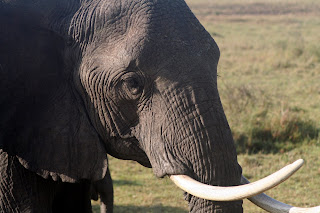 Another short tempered colossus of the savannah with eyesight fouled up by TV and comic books yet still possessing a keen sense of smell. I mean just look at that nose*. The strip and run plan is the same as for the buffalo, but no tree climbing with these guys as elephants are renowned as highly skilled tree climbers (their secret is in the way they knock over the tree before climbing on top of it). As a side note, elephants are said to have a strong aversion for bees, so you may want to take an ounce of prevention and consider carrying a bustling hive around with you on your next safari.
*Fact: an elephant’s nose is actually an in-line series of over 300 separate noses, each more powerful than the last.
Rhinoceros (Swahili: Kifaru) –


Large animals. Weird animals. Large and weird animals. The kinds of creatures you wouldn’t want to run into in a dark alley, or any alley regardless of lighting. Thus begs the question, what do you do if you do happen to cross paths with one of these walking wonders of the natural world? Simple. Ask the Maasai. The Maasai are widely regarded throughout Kenya as the baddest, most reliable ally to have in your corner when facing off against a man-eating, man-stomping, or otherwise man-harm-inflicting animal of any size. But what if you don’t have a Maasai warrior on hand when you happen upon one of these beasts of the savannah? Rest assured, I’ve taken your lack of preparedness into account and have gone out and done your homework for you, seeking the advice of a seasoned Maasai warrior/Peace Corps language instructor on how to handle encounters with Africa’s baddest of the bad.
Buffalo (Swahili: Nyati) –
Don’t let their docile appearance and cute old west bartender style hair-do fool you, the last thing these guys are going to do when trouble breaks out is go hiding under the counter. While there’s never a truly safe time to be around one of these wooly behemoths they are most dangerous when startled, so fancy card tricks, surprise birthday parties, and just showing up at their apartment without calling first are all strict No No’s. Having spent many years growing up sitting entirely too lose to the television despite the advice of their parents, their eyesight is pitiful, though their sense of smell is rivaled only by blood hounds and breakfast cereal tracking toucans. If chased the best course of action is to somehow strip off your top layer of clothes while running away (easier when wearing traditional Maasai garb or one of those goofy khaki safari shirts with all the pockets than when sporting a skin tight T-shirt and Wranglers), toss them on the ground, and continue running while the buffalo theoretically stays behind and wrestles with your abandoned duds. If that doesn’t work, climb a strong looking tree and wait for your horned friend at the bottom to lose interest in flattening you and wander away.Elephant (Swahili: Ndovu) –
Another short tempered colossus of the savannah with eyesight fouled up by TV and comic books yet still possessing a keen sense of smell. I mean just look at that nose*. The strip and run plan is the same as for the buffalo, but no tree climbing with these guys as elephants are renowned as highly skilled tree climbers (their secret is in the way they knock over the tree before climbing on top of it). As a side note, elephants are said to have a strong aversion for bees, so you may want to take an ounce of prevention and consider carrying a bustling hive around with you on your next safari.*Fact: an elephant’s nose is actually an in-line series of over 300 separate noses, each more powerful than the last.
Rhinoceros (Swahili: Kifaru) –
Sadly, these creatures are being spotted less and less in the wild due to online poaching and to thousands of hours of their lives wasted away in front of a computer by solitaire and online gaming. If you are lucky enough to spot and be chased by one of these magnificent and rare creatures the best strategy is to run in a zig-zag pattern which I think has something to do with taking advantage of the blind spot created by it’s horn. As a side note, Rhinoceretopses are reputedly terrible at managing personal finances, so your should never loan them money, but if you can somehow turn this to your advantage when trying to escape then go for it.
Crocodiles (Swahili: Mamba) –
Crocodiles (Swahili: Mamba) –
Best just to play it safe here and not go near any water that’s not in a sealed bottle.
Hippopotamus (Swahili: Kiboko) –

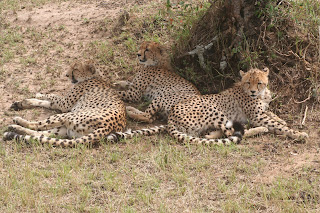 (Three leopards stealthily disguised as cheetahs)
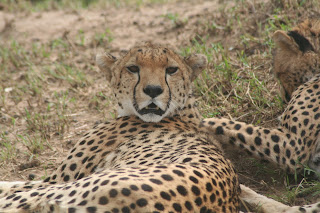
 Cowards. Will usually run away rather than attack so long as you don’t do something stupid like jump on it’s back try to ride it.
Lions (Swahili: Simba) –
Hippopotamus (Swahili: Kiboko) –
Insomnia. Binge Eating Disorder. Agoraphobia. These poor creatures are case studies in multiple complex disorders and should be commended for simply having the strength and the courage to get out of bed every evening. No matter how bad last night was for you theirs was almost certainly worse, so you can count on them being in a pretty irritable mood should you cross paths in the wild. Much like this buffalo brethren to whom they have no relation, these water dwelling behemoths are in no mood for surprises. The best course of action should you encounter one of these groggy swamp monsters is to run as fast as you can and never put yourself between a hippo and water.
Leopard (Swahili: Chui) –
Leopard (Swahili: Chui) –
(Three leopards stealthily disguised as cheetahs)Sporting a sleek spotted coat, these cats look good and they know it, spending most of their day trying to avoid unwanted attention from adoring fans by hiding out in trees, hollowed out log, and other incognito places. Being extremely concerned with maintaining their good looks, leopards will shy away from any conflict that threatens to disfigure their chiseled facial features, thus grabbing the jaws of a pouncing leopard is said to render them submissive and let them know you’re no one to be messing with. How exactly to grab a hold of their jaws while avoiding the sharp claws and teeth was not so well explained. Good luck.
Cheetah (Swahili: Duma) –
Cheetah (Swahili: Duma) –
Usually will not attack humans. If they do become confrontational try challenging them to a race and then take off in a different direction.
Zebras (Punda Milia), Wildebeests (Kongoni), Giraffes (Twiga), Gazelles (Swala), etc. –
Zebras (Punda Milia), Wildebeests (Kongoni), Giraffes (Twiga), Gazelles (Swala), etc. –
Cowards. Will usually run away rather than attack so long as you don’t do something stupid like jump on it’s back try to ride it.Lions (Swahili: Simba) –
The baddest of the bad. If you bump into one of these guys you messed up somewhere. I mean really messed up, like punched a nun or something like that. But not to worry, handling them is merely a lesson in counter-bullying 101. If you run into one of these snuggly, cuddly faced killers the first thing you need to do is stand your ground, act cool, don’t run away, and don’t pursue. As the Swahili saying goes “Zivuta Kama Uko Nazo” or “Smoke ‘em if you got ‘em”.
If the lion approaches continue to stand your ground and it will think twice about whether or not it really wants a piece of you. If he does, hey, don’t blame me for just standing around, like you were really going to outrun a freaking lion anyway, I don’t care how many touchdowns you scored that one time playing touch football. If he walks off then you do the same in a different direction, preferably into a house or car or back over the zoo railing or something. If there’s more than one lion then get the heck out of there, they’ll just surround you eat you regardless of how cool and nonchalant that leather jacket makes you look. Also, finding closure in your life and spiritual oneness would be a good idea right about now.
Friday, October 14, 2011
Moral Dilemmas
There are generally said to be two types of season in Kenya. Rainy seasons, and the seasons spent waiting for the rainy seasons. The rains are the powering force behind life in the region and to denounce them would be like driving a needle made from frozen lemon juice under the eyelids of every man, woman, and child in the country. Rewards of cash and rare jewels have been promised to the mad genius who can produce a device capable of harnessing the power of precipitation, while those who hint at even the slightest dissatisfaction with gloomy weather are advised to pack up and leave or risk being declared enemies of the state.
Requesting the rain to go away and come back another day is considered treason under the Kenyan constitution, so far be it from me to even entertain the thought. But a plague has descended upon my humble residence. A foul, putrefying scourge. The kind of unrelenting assault on the senses that makes rookie cops throw up into handkerchiefs, eventually dashing behind their squad cars to finish the job. It came on slightly at first. A faint, stale odor floating on the night air, creeping into my nostrils during my sleeping hours. I raise my head and try and identify the reeking source, but the delicate olfactory trail is lost as swiftly as it came on. Days pass and the haunting fragrance gathers potency, always strongest when I lay my head down to rest. “This pillow case needs to be washed,” I think, and the next day I seek to assuage the aromatic malady through a combination of bleach, boiled holy water, and elbow grease. The sanitizing miracle tonic works wonders initially, but the reprieve from my pungent invisible foe is short lived. Repeated attempts to cleanse my linens of this malodorous hex are becoming less and less effective, making it clear that a moment of resolution is fast approaching. The breaking point arrives one night as I’m drawn out of a deep, restful slumber by an overpoweringly rotten odor reminiscent of an aged wheel of fetid cheese which has been stored for seventeen sweltering summer months in the pouch of a sweaty kangaroo.
“Enough”, I decry, though it comes out as an inaudible groan in my still half sleeping state, as I cast the putrid blend of cotton and limburger as far from me as I can without leaving the comfort of my mosquito net. Having one of the rankest pillows in the history of stinky sleep paraphernalia is an inconvenient, though manageable, problem. Running into such a problem at the beginning of the rainy season, a time when anything set out to dry only becomes more drenched, is kind of a drag. I would never ask for anything that would make life here more difficult for those here whose livelihood depends on the rain, but one sunny afternoon couldn’t hurt, right?
Requesting the rain to go away and come back another day is considered treason under the Kenyan constitution, so far be it from me to even entertain the thought. But a plague has descended upon my humble residence. A foul, putrefying scourge. The kind of unrelenting assault on the senses that makes rookie cops throw up into handkerchiefs, eventually dashing behind their squad cars to finish the job. It came on slightly at first. A faint, stale odor floating on the night air, creeping into my nostrils during my sleeping hours. I raise my head and try and identify the reeking source, but the delicate olfactory trail is lost as swiftly as it came on. Days pass and the haunting fragrance gathers potency, always strongest when I lay my head down to rest. “This pillow case needs to be washed,” I think, and the next day I seek to assuage the aromatic malady through a combination of bleach, boiled holy water, and elbow grease. The sanitizing miracle tonic works wonders initially, but the reprieve from my pungent invisible foe is short lived. Repeated attempts to cleanse my linens of this malodorous hex are becoming less and less effective, making it clear that a moment of resolution is fast approaching. The breaking point arrives one night as I’m drawn out of a deep, restful slumber by an overpoweringly rotten odor reminiscent of an aged wheel of fetid cheese which has been stored for seventeen sweltering summer months in the pouch of a sweaty kangaroo.
“Enough”, I decry, though it comes out as an inaudible groan in my still half sleeping state, as I cast the putrid blend of cotton and limburger as far from me as I can without leaving the comfort of my mosquito net. Having one of the rankest pillows in the history of stinky sleep paraphernalia is an inconvenient, though manageable, problem. Running into such a problem at the beginning of the rainy season, a time when anything set out to dry only becomes more drenched, is kind of a drag. I would never ask for anything that would make life here more difficult for those here whose livelihood depends on the rain, but one sunny afternoon couldn’t hurt, right?
Tick Tock
The concept of time has systematically blown the minds of individuals who have made any attempt to understand it since before the dawn of civilization. Wormholes and black holes. Relativity theories and flux capacitors. It seems the deeper we delve into the subject the more confusing, depressing, and frankly uninteresting the whole matter becomes. Even the time-space guru Einstein was known to feign exaggerated yawns and bellow out “BO-RING!” when engaged on the subject by students and intellectual colleagues for more than a few minutes. But despite our lack of understanding on the illusory subject, time plays an important role in various parts of the world, and Kenya is no different.
Some might say that time holds a unique place in Kenya in that it seems to have no place at all. 9 AM meetings regularly start at 2, “right now” could refer to anytime today, and the phrase “next week” could be three months from now or beyond. Indeed, the Swahili proverb “Haraka Haraka Haina Baraka” (Hurry Hurry Has No Blessing) is seemingly followed to the letter. But there is a system here. An unspoken set of rules and guidelines driving the day to day agenda of those living far outside the shadows of the city. A protocol that everyone understands and adheres to. An etiquette that is the bane of anyone who foolishly tries to push their own agenda without trying to understand the culture they’re in. Who would be foolish enough to waste the morning in an early meeting when that’s the coolest time to work in the field? Why would anyone risk the social isolation that would result by not stopping to greet everyone they pass on the way to the village or by not attending the 3 day funeral of their friend’s cousin’s grandfather just so they could meet a deadline? Those from clock dominated societies seem to run into an unending sea of frustration when they cross through the wormhole and into this alternate chronometrical society, so it’s important to remember things will happen when they happen. A meeting will start when it starts, the shop will open when it opens, and a 6 month late blog post is considered right on time.
Some might say that time holds a unique place in Kenya in that it seems to have no place at all. 9 AM meetings regularly start at 2, “right now” could refer to anytime today, and the phrase “next week” could be three months from now or beyond. Indeed, the Swahili proverb “Haraka Haraka Haina Baraka” (Hurry Hurry Has No Blessing) is seemingly followed to the letter. But there is a system here. An unspoken set of rules and guidelines driving the day to day agenda of those living far outside the shadows of the city. A protocol that everyone understands and adheres to. An etiquette that is the bane of anyone who foolishly tries to push their own agenda without trying to understand the culture they’re in. Who would be foolish enough to waste the morning in an early meeting when that’s the coolest time to work in the field? Why would anyone risk the social isolation that would result by not stopping to greet everyone they pass on the way to the village or by not attending the 3 day funeral of their friend’s cousin’s grandfather just so they could meet a deadline? Those from clock dominated societies seem to run into an unending sea of frustration when they cross through the wormhole and into this alternate chronometrical society, so it’s important to remember things will happen when they happen. A meeting will start when it starts, the shop will open when it opens, and a 6 month late blog post is considered right on time.
Monday, May 16, 2011
A Heroic Tale
It's Mother's Day in most parts of the world (at least it was when I started scribbling this down on paper), and what better way to celebrate than with a special blog post dedicated to that most esteemed class of individual, the one whose sweat and tears oil the machine that drives this country, the one without whom all life on the African continent would grind to an inoperable stand-still. I am referring, of course, to the Kenyan Mama. Bearing the weight of Kenyan society on her head like a bucket of water 41 million people heavy, the life of this matriarch is a test of character and endurance so brutal it makes the Ironman look like a shuffle board match. With feet strong enough to walk over broken glass, and hands tough enough to hold flaming coals, these under-appreciated females of the pride are capable of enduring just about anything the world can throw their way. What better example than the story of Mekatilili.
Who is Mekatilili you ask? Only one of the baddest mamas ever to walk the sandy loams of Kenya. To follow her story we travel back to the early part of the 20th century. Black and white are dominating fashion, the electric slide is still powered by a hand-crankable device, and territories such as Mexico, India, and Kenya are increasingly resisting their colonial rulers.
As the local story goes, a group of freedom fighters from the Giryama tribe are engaged in a bitter struggle against their British occupiers, among them one traditional healer by the name of Mekatilili (meaning mother of Katilili). During this period of unrest, the son of our heroine, Katilili, is captured by a British officer who answers to the name of Champion and transported to the western Kenyan outpost Kisii where he is to be imprisoned. But Mekatilili won't have it. Powered by the inextinguishable fire of maternal instinct, the herbalist liberator journeys on foot nearly 900 kilometers, crossing hippo infested waters and outrunning cheetahs across lion covered savannahs for about two weeks, arriving finally at theshold of her son's prison.
"Champion, give me back my son", she demands, but the British officer, alarmed to see Mekatilili so far from the battle grounds of the coast, accuses her of witchcraft and refuses her request. Resisting the urge to double over the British gentleman by releasing one of her trademark reverse spin kicks into his midsection our naturalist instead takes her leave.
The following day Mekatilili again appears at the gate, begging a word with her son's jailor. Champion, through a mask of contempt and thinning patience, decides to oblige our journeying hero's request to parley. As the man-at-arms warily approaches the place where Mekatilili is standing, wisely keeping his distance as word of her infamous spin-kicking ability has preceeded her, she presents to him a mother hen with one of her chicks, imploring the foreign agent to seperate the aviary toddler from it's mother. Cautiously, Champion inches forward and begins to pull the young fledgling away from the hen but as he does, the matriach fowl launches forward into a desperate, feather drawn flurry of pecks, scratches, headbutts, and any other offensive maneuver you can imagine a chicken employing to selflessly defend her young.
As the commander of forces reels backward under the weight of the hen's "to the death" offensive Mekatilili says to him, "That is why I have come. You have taken me son from me", again demanding the return of her child.
Champion, through a thick emotional shell hardened by years of fighting for the empire, feels the heat of Mekatilili's words, his insides melting from the emotion that fuels them. At that moment he realizes the fire burning inside of her is unlike any that he has ever encountered on the field of battle, and, in a gesture of respect and understanding displayed all too rarely in our world, returns to Mekatilili her imprisoned son. Reunited, mother and son begin their long journey together back toward their coastal homeland, the chicken went on to invent some kind of synthetic down, while Champion probably quit the army and went to live on top of a mountain to study zen or mushrooms or something.
So children let's pay homage to the women who brought us into this world. Not because they crossed a country to protect us, but because we know they would.
Thursday, March 31, 2011
Sunday, February 13, 2011
What's Your Sign?
Kenya is a nation, and like most nations, republics, and confederacies (fan-based nations excluded) it is chock-full of nationly tidbits and national what-nots. National bird: the lilac breasted roller. National anthem: Ee Mungu Nguvu Yetu (Oh God of All Creation). National flower: Taifa brand sifted maize meal. But no national treasure is more fascinating, more enigmatic, or, frankly, easier to blog about than the national automobile: the Matatu. Poorly understood by those outside of Kenya, the most common misconception surrounding these rolling games of twister is that each one is the same as the next. In fact, each matatu, tuk tuk, pikipiki and bodaboda is a unique entity, with its own personality, quirks, and habits. So how is the common, lay commuter supposed to be able to know the flavor of their chariot before they enter? Well, apart from the wild color schemes and lavish neon lighting, each vehicle, like a Spanish galleon setting out on the high seas, bears a unique epithet distinguishing it from the rest of the fleet. Sometimes written using old English lettering, sometimes written using old English grammar, here are a few monikers you might spot traversing Kenya's motorways:
Game of Chance - Not the words you want to see on a vehicle you are about to entrust your safety to.
Game of Chance - Not the words you want to see on a vehicle you are about to entrust your safety to.
Tripple M - Yes, that's 'triple' spelled with two "P"'s. This name is not so much humorous as it is flat out confusing. Try as I might, I can't think of any triumvirate of "M" related anything that would be witty or significant enough to brand in semipermanent decal lettering across anything. My best guess is that the monster mash is somehow involved.
Street Credibility - I'm pretty sure that anywhere street cred is important, referring to it as 'street credibility' is an instant way to lose it.
Jesus Loves (written in blood) - Take that Satan. You're not the only one who can write your name in sanguinous body fluids and look cool.
Peace Corps - Finally, some props.
Dangerous - See "Game of Chance".
Addicted - "Sure I'll get in, but would you mind walking in a straight line first?"
Say No 2 Drugs - Would you please talk to 'Addicted'?
Big Machine. Permitted to Kill - I might be more intimidated by this if I weren't big enough to physically overturn the tuk tuk it was printed on without spilling a glass of water.
Xtreme Grace - Other than conjuring up the mental image of a tutu clad ballerina slamming a Mountain Dew while jumping a pink, flower patterned skateboard over a serene meadow filled with the most adorable man eating puppies you can possibly imagine while a string orchestral arrangement of In-A-Gadda-Da-Vida floats in the air, I'm not quite sure how to react to such an overpoweringly gentle name.
Oh Yes 2 - Sounds promising, but what happened to the first "Oh Yes"...?
Da Promise - Not to sure what this one is referring to, but you can be certain there's a Bears fan behind the wheel.
Karl Malone - No joke here, Kenyans just really respect and admire Karl Malone.
Desire - The latest matatu from Calvin Klein.
Grand Hustler - Better make sure you get some sort of written agreement on the fare before hopping into this one.
Pole Pole Kenya Project group (translation: Slow Kenya Project Group) - Got a Deadline? Well...then...you probably shouldn't outsource any of your work to these guys.
And my favorite...
Slow - Ok, granted the rest of the name was scratched off, it doesn't exactly instill a lot of confidence...I think I'll just walk.
Tuesday, February 8, 2011
Customer Loyalty
Small business is something more of an art than a science here in the forgotten rural villages of Kenya's coastal province. "Competitors" find it commonplace to refer customers to one another, supply and demand has almost no sway over local prices, and the thought of a price war...well...there's just isn't any thought at all. No, nestled here on the outermost fringes of the corporate world's leering, opportunistic gaze, the rules of capitalism just don't seem to have fully taken hold. But in these dusty streets lined with rows of shops, or rather multiple duplicates of the same shop, one has little to go by, save for family and tribal loyalties, when deciding which duka shall be the deserving recipient of their repeat patronage. Enter customer service.
To identify the origin of my own consumer loyalties I need look no further back than that fateful Sunday afternoon during a period that the majority of the world generally recognizes as autumn. Now, this not the kind of Sunday afternoon Lionel Richie would sing about, or the kind that would involve a picnic basket and a golden retriever with biblical first and middle names, a penchant for catching frisbees, and an uncontrollable habit of randomly soiling the carpet despite being the perfect companion in nearly every other way. Nor is this the kind of Sunday afternoon where legions of boozed-up armchair quarterbacks crowd in front of their TV sets to passionately root on their team, which has to close out the season with 9 straight wins in order to have a winning record and chance at the playoffs. No, this is the kind of Sunday afternoon that I imagine you might encounter during the Spanish Inquisition, where the pious are in church and the less pious are staying out of site so as not to broadcast the inadequacy of their piety to those who would have them tied to a ferrel donkey and dragged through a breyer patch. It is on this type of Sunday afternoon, this holiest of afternoons, that I step out from my humble abode in search of some kind of produce to prepare as part of my evening meal.
Appetancy driving my steps, I start rounding the very limited array of options which may be even remotely capable of satisfying my desires for vegetable goodness. The first stop in my procession, the village market; a helter-skelter assemblage of branches, birches, and sticks lashed together into a makeshift, chest high, six foot by two foot table. Selection at this bazaar is anything but predictable, being totally dependent on local harvests, weather patterns, and whoever decides to happen upon to the market that day for the purpose of sprawling their various surpluses out across the surface overtall bench. The rules of exchange here are simple: anything on the table is for sale, anything under the table....well, those are probably somebody's children. Whether the result of my having gotten off to a late start or a flat out absence of variety from the day's outset, by the time I arrive I find the lone eatable on the counter to be a basket full of dried makumba, a small river dwelling fish that, if you didn't know better, you may mistake for a newly born sardine. Not exactly the ideal side dish for an herbivorous individual such as myself. Having already gone the previous day without taking in anything higher than the first layer of the food pyramid, again due to fluctuations in the market, my prospects of consuming anything even remotely resembling a balanced diet on this weekend look grim.
Spirits dashed, palate unsatiated, my mind, rolling through the short list of options still available, steers me toward the local supermarket, a two meter by two meter establishment whose produce section is consistent of a small cardboard box full of onions which, surprisingly, is always well stocked. Fighting off the urge to completely surrender myself to dejection and discouragement, I enter dim, windowless structure and exchange greetings with the shop keeper, a young man no older than myself with a persistent close-lipped smile, a pair of brightly attentive eyes, and a deep yet soft spoken voice that is like a smooth, melodic butter spread in a perfect grade over the eardrums.
Formalities observed, I cut straight to the chase, "Do you have any vegetables besides onions?" I pry inquisitively, like a zealous gumshoe poking around for a hot lead.
Eyes shifting, fingertips rapping tersely against one another in a disjointedly rhythmic manner, he is clearly mulling over the best way to tell me 'No'. His unfocusing gaze continues to dart across walls lined floor to ceiling with merchandise as though scanning for some unseen object when suddenly his eyebrows shoot up like a pair of freshly roasted toaster pastries and he moves to his left with a purpose typically reserved for mothers who are hoisting cars up off of small children. Reaching up on a high shelf he pulls down and, in the same motion, dexterously bags a pair of glowing red tomatoes. Already willing to pay any price demanded of me I start fumbling through my pockets for coins, bills, property deeds, permenant teeth, and anything else mildly of value.
"How much?" I query, doing little to disguise my disadvantage at the bargaining table.
"Just take them," he tells me, the thought to charge me never crossing his mind and he extends to me the bag of what was clearly meant to be a part of his own dinner.
Realizing that declining this gesture of kindness would be about as culturally acceptable as delivering a roundhouse kick to the stomach, not to mention being too starved of variety to try, I accept the satchel of fruit like a Nobel Peace Prize, feeling as though I should make some memorable speech to commemorate the moment. I recognize that no combination of nouns, verbs, or adjectives could adequately express my gratitude for what would be the best tomatoes I've ever consumed, rather, I hope that my undying customer loyalty will help convey that sentiment.
Subscribe to:
Posts (Atom)